

Abstract Impairment of hand motor function is a frequent consequence after a stroke and strongly determines the ability to regain a self-determined life. An influential research strategy for improving motor deficits is the combined application of behavioral training and non-invasive brain stimulation of the motor cortex (M1). However, a convincing clinical translation of the present stimulation strategies has not been achieved yet. One alternative and innovative approach is to target the functionally relevant brain network-based architecture, e.g., the dynamic interactions within the cortico-cerebellar system during learning. Here, we tested a sequential multifocal stimulation strategy targeting the cortico-cerebellar loop. Anodal transcranial direct current stimulation (tDCS) was applied simultaneously to a hand-based motor training in N = 11 chronic stroke survivors during four training sessions on two consecutive days. The tested conditions were: sequential multifocal (M1-cerebellum (CB)-M1-CB) vs. monofocal control stimulation (M1-sham-M1-sham). Additionally, skill retention was assessed 1 and 10 days after the training phase. Paired-pulse transcranial magnetic stimulation data were recorded to characterize stimulation response determining features. The application of CB-tDCS boosted motor behavior in the early training phase in comparison to the control condition. No faciliatory effects on the late training phase or skill retention were detected. Stimulation response variability was related to the magnitude of baseline motor ability and short intracortical inhibition (SICI). The present findings suggest a learning phase-specific role of the cerebellar cortex during the acquisition of a motor skill in stroke and that personalized stimulation strategies encompassing several nodes of the underlying brain network should be considered.
Publication scientifique
Multi-focal Stimulation of the Cortico-cerebellar Loop During the Acquisition of a Novel Hand Motor Skill in Chronic Stroke Survivors
Autres publications de la plateforme
Causal disconnectomics of motion perception networks: insights from transcranial magnetic stimulation‐induced...
Raffin, Estelle; Salamanca‐Giron, Roberto F.; Huxlin, Krystel R.; Reynaud, Olivier; Mattera, Loan; Martuzzi, Roberto; Hummel, Friedhelm C.
The Journal of Physiology
Boosting hemianopia recovery: the power of interareal cross-frequency brain stimulation
Raffin, Estelle; Bevilacqua, Michele; Windel, Fabienne; Menoud, Pauline; Salamanca-Giron, Roberto F; Feroldi, Sarah; Zandvliet, Sarah B; Ramdass, Nicola; Draaisma, Laurijn; Vuilleumier, Patrik; Guggisberg, Adrian G; Bonvin, Christophe; Fleury, Lisa; Huxlin, Krystel R; Beanato, Elena; Hummel, Friedhelm C
Brain
Return of the GEDAI: Unsupervised EEG Denoising based on Leadfield Filtering
Ros, Tomas; Férat, Victor; Huang, Yingqi; Colangelo, Cristina; Kia, Seyed Mostafa; Wolfers, Thomas; Vulliemoz, Serge; Michela, Abele
Multivariate deep phenotyping reveals behavioral correlates of non-restorative sleep in 22q11.2...
Reich, Natacha; Imparato, Andrea; Cataldi, Jacinthe; Thillainathan, Niveettha; Delavari, Farnaz; Schneider, Maude; Eliez, Stephan; Siclari, Francesca; Sandini, Corrado
Psychiatry Research
EEG microstate D as psychosis-specific correlate in adolescents and young adults...
Liebrand, Matthias; Katsarakis, Angelos; Josi, Johannes; Diezig, Sarah; Michel, Chantal; Schultze-Lutter, Frauke; Rochas, Vincent; Mancini, Valentina; Kaess, Michael; Hubl, Daniela; Koenig, Thomas; Kindler, Jochen
Schizophrenia Research
EEG correlates of egocentric and altercentric biases in forensic cases with...
Rochas, Vincent; Montandon, Marie-Louise; Rodriguez, Cristelle; Herrmann, François R.; Eytan, Ariel; Pegna, Alan J.; Michel, Christoph M.; Giannakopoulos, Panteleimon
Frontiers in Neuroscience
Journal de publication
The Cerebellum
Auteurs:
Wessel, M.J.; Draaisma, L.R.; Durand-Ruel, M.; Maceira-Elvira, P.; Moyne, M.; Turlan, J.-L.; Mühl, A.; Chauvigné, L.; Koch, P.J.; Morishita, T.; Guggisberg, A.G.; Hummel, F.C.
Date de publication:
Plateforme:
Études récentes de la plateforme
Comment les souvenirs évoluent-ils avec le temps ?
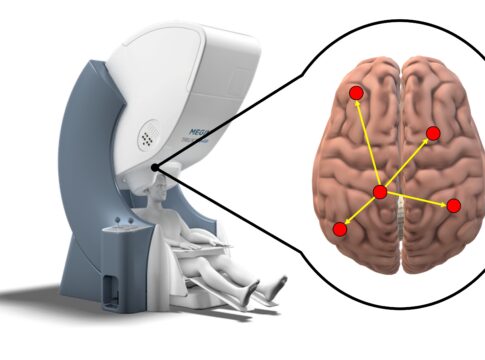
Une fenêtre sur le cerveau
La magnétoencéphalographie (MEG) nous permet d’enregistrer l’activité neuronale avec une grande précision spatiale et temporelle.
Nous utilisons cette technique...
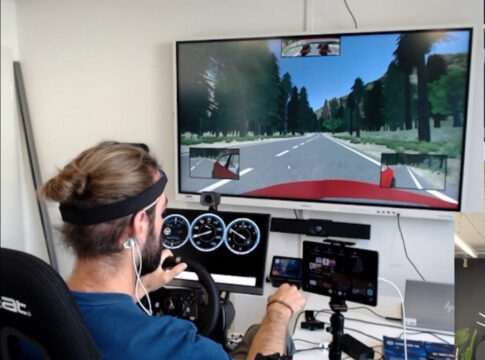
NeuroMetrics
Une évaluation UX multimodale intégrée
NeuroMetrics combine l'électroencéphalographie (EEG), l'électromyographie (EMG), l'électrocardiographie (ECG) et des mesures basées sur la vidéo telles que l'analyse du taux...
Se débarrasser des cauchemars
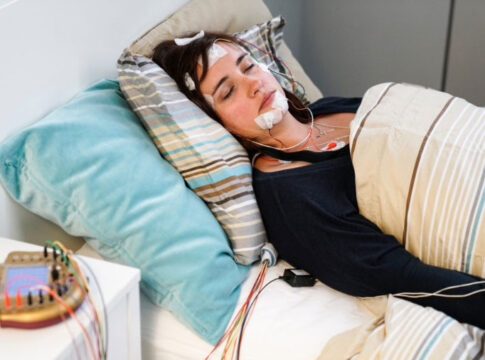
Réactiver les souvenirs positifs pendant le sommeil
Les patients travaillent avec un psychiatre ou un psychologue pour réimaginer la fin d'un cauchemar récurrent —...