
Abstract Visual field loss is a common consequence of stroke and manifests in approximatively one-third of patients in the chronic stage. Such loss can significantly impact daily life activities, compromising tasks such as reading, navigating or driving. Although slow and labour intensive, evidence suggests that early interventions with tailored rehabilitation programmes might stimulate visual recovery and improve quality of life in stroke survivors. To enhance the effects of such rehabilitation programmes, we designed a novel, non-invasive, pathway-specific, physiology-inspired cross-frequency brain stimulation protocol, where complex oscillatory signal integration was inferred from phase–amplitude coupling of oscillatory signals between the primary visual cortex and the motion-sensitive medio-temporal area. Sixteen stroke patients were enrolled in a double-blind, randomized, cross-over trial, during which they performed two blocks of 10 daily training sessions of a direction discrimination task, combined with one of the two cross-frequency transcranial alternative brain stimulation (cf-tACS versus control cf-tACS) conditions. We found that the cf-tACS condition promoting feedforward visual inputs to the medio-temporal area significantly enhanced motion discrimination performance and shifted visual field borders (i.e. through localized enlargement of isopters). Behavioural improvements associated with a change in oscillatory activity within motion processing pathways were proportional to the amount of residual structural fibres along these pathways and perilesional primary visual cortex activity. In sum, we report, for the first time, that cf-tACS, a novel, pathway-specific, physiology-inspired brain stimulation approach, is able to boost the efficacy of perceptual training, restoring visual motion processing and reducing the severity of visual impairments in adult stroke patients.
Publication scientifique
Boosting hemianopia recovery: the power of interareal cross-frequency brain stimulation
Autres publications de la plateforme
Causal disconnectomics of motion perception networks: insights from transcranial magnetic stimulation‐induced...
Raffin, Estelle; Salamanca‐Giron, Roberto F.; Huxlin, Krystel R.; Reynaud, Olivier; Mattera, Loan; Martuzzi, Roberto; Hummel, Friedhelm C.
The Journal of Physiology
A graphical pipeline platform for MRS data processing and analysis: MRSpecLAB
Xiao, Ying; Kaiser, Antonia; Kockisch, Matthias; Back, Alex; Carlet, Robin; Liu, Xinyu; Huang, Zhiwei; Döring, André; Widmaier, Mark; Xin, Lijing
Frontiers in Neuroimaging
Brain activation for language and its relationship to cognitive and linguistic...
Balboni, Irene; Rampinini, Alessandra; Kepinska, Olga; Berthele, Raphael; Golestani, Narly
Cerebral Cortex
Resting-state functional connectivity abnormalities in subjective cognitive decline: A 7T MRI...
Pievani, M.; Ribaldi, F.; Toussas, K.; Da Costa, S.; Jorge, J.; Reynaud, O.; Chicherio, C.; Blouin, J.L.; Scheffler, M.; Garibotto, V.; Jovicich, J.; Jelescu, I.O.; Frisoni, G.B.
Neurobiology of Aging
Translational research approach to social orienting deficits in autism: the role...
Contestabile, Alessandro; Kojovic, Nada; Casarotto, Giulia; Delavari, Farnaz; Hagmann, Patric; Schaer, Marie; Bellone, Camilla
Molecular Psychiatry
EEG correlates of egocentric and altercentric biases in forensic cases with...
Rochas, Vincent; Montandon, Marie-Louise; Rodriguez, Cristelle; Herrmann, François R.; Eytan, Ariel; Pegna, Alan J.; Michel, Christoph M.; Giannakopoulos, Panteleimon
Frontiers in Neuroscience
Journal de publication
Brain
Auteurs:
Raffin, Estelle; Bevilacqua, Michele; Windel, Fabienne; Menoud, Pauline; Salamanca-Giron, Roberto F; Feroldi, Sarah; Zandvliet, Sarah B; Ramdass, Nicola; Draaisma, Laurijn; Vuilleumier, Patrik; Guggisberg, Adrian G; Bonvin, Christophe; Fleury, Lisa; Huxlin, Krystel R; Beanato, Elena; Hummel, Friedhelm C
Date de publication:
Plateforme:
Études récentes de la plateforme

Pourquoi certains cerveaux adorent apprendre les langues
Aptitude au langage dans le cerveau et le comportement
Les participants réalisent un protocole d’IRM complet, nous permettant d’étudier à la fois la structure...
Reconstruire l’esprit de nos ancêtres
Étudier la cognition physique dans la phylogénie
Tester les individus dans leur environnement naturel permet d’offrir un cadre écologiquement valide à l’étude de la cognition.Pour...
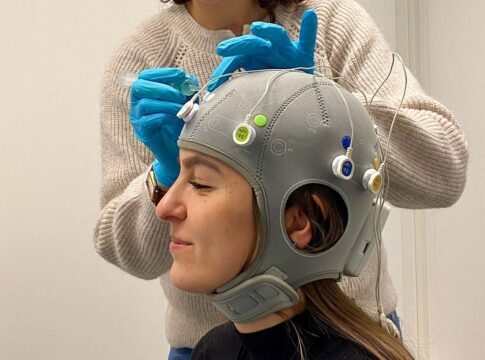
Stimulation cérébrale à domicile pour booster la cognition
Améliorer la cognition
Explorer la stimulation cérébrale non invasive pour soutenir les fonctions exécutives
La stimulation transcrânienne par courant alternatif (tACS) utilise de faibles...