

Abstract Objective . Selective neuromodulation of deep brain regions has for a long time only been possible through invasive approaches, because of the steep depth-focality trade-off of conventional non-invasive brain stimulation (NIBS) techniques. Approach . An approach that has recently emerged for deep NIBS in humans is transcranial Temporal Interference Stimulation (tTIS). However, a crucial aspect for its potential wide use is to ensure that it is tolerable, compatible with efficient blinding and safe. Main results . Here, we show the favorable tolerability and safety profiles and the robust blinding efficiency of deep tTIS targeting the striatum or hippocampus by leveraging a large dataset (119 participants, 257 sessions), including young and older adults and patients with traumatic brain injury. tTIS-evoked sensations were generally rated as ‘mild’, were equivalent in active and placebo tTIS conditions and did not enable participants to discern stimulation type. Significance . Overall, tTIS emerges as a promising tool for deep NIBS for robust double-blind, placebo-controlled designs.
Publication scientifique
Safety, tolerability and blinding efficiency of non-invasive deep transcranial temporal interference stimulation: first experience from more than 250 sessions
Autres publications de la plateforme
Causal disconnectomics of motion perception networks: insights from transcranial magnetic stimulation‐induced...
Raffin, Estelle; Salamanca‐Giron, Roberto F.; Huxlin, Krystel R.; Reynaud, Olivier; Mattera, Loan; Martuzzi, Roberto; Hummel, Friedhelm C.
The Journal of Physiology
Boosting hemianopia recovery: the power of interareal cross-frequency brain stimulation
Raffin, Estelle; Bevilacqua, Michele; Windel, Fabienne; Menoud, Pauline; Salamanca-Giron, Roberto F; Feroldi, Sarah; Zandvliet, Sarah B; Ramdass, Nicola; Draaisma, Laurijn; Vuilleumier, Patrik; Guggisberg, Adrian G; Bonvin, Christophe; Fleury, Lisa; Huxlin, Krystel R; Beanato, Elena; Hummel, Friedhelm C
Brain
A graphical pipeline platform for MRS data processing and analysis: MRSpecLAB
Xiao, Ying; Kaiser, Antonia; Kockisch, Matthias; Back, Alex; Carlet, Robin; Liu, Xinyu; Huang, Zhiwei; Döring, André; Widmaier, Mark; Xin, Lijing
Frontiers in Neuroimaging
Brain activation for language and its relationship to cognitive and linguistic...
Balboni, Irene; Rampinini, Alessandra; Kepinska, Olga; Berthele, Raphael; Golestani, Narly
Cerebral Cortex
Resting-state functional connectivity abnormalities in subjective cognitive decline: A 7T MRI...
Pievani, M.; Ribaldi, F.; Toussas, K.; Da Costa, S.; Jorge, J.; Reynaud, O.; Chicherio, C.; Blouin, J.L.; Scheffler, M.; Garibotto, V.; Jovicich, J.; Jelescu, I.O.; Frisoni, G.B.
Neurobiology of Aging
Translational research approach to social orienting deficits in autism: the role...
Contestabile, Alessandro; Kojovic, Nada; Casarotto, Giulia; Delavari, Farnaz; Hagmann, Patric; Schaer, Marie; Bellone, Camilla
Molecular Psychiatry
Journal de publication
Journal of Neural Engineering
Auteurs:
Vassiliadis, Pierre; Stiennon, Emma; Windel, Fabienne; Wessel, Maximilian J; Beanato, Elena; Hummel, Friedhelm C
Date de publication:
Plateforme:
Études récentes de la plateforme

Pourquoi certains cerveaux adorent apprendre les langues
Aptitude au langage dans le cerveau et le comportement
Les participants réalisent un protocole d’IRM complet, nous permettant d’étudier à la fois la structure...
Reconstruire l’esprit de nos ancêtres
Étudier la cognition physique dans la phylogénie
Tester les individus dans leur environnement naturel permet d’offrir un cadre écologiquement valide à l’étude de la cognition.Pour...
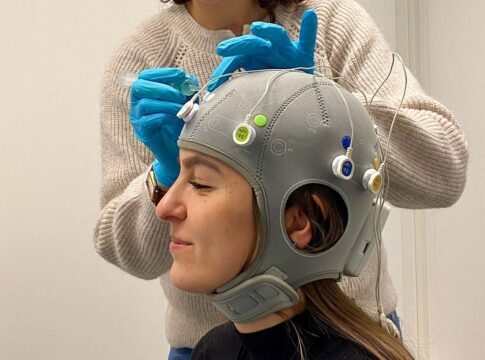
Stimulation cérébrale à domicile pour booster la cognition
Améliorer la cognition
Explorer la stimulation cérébrale non invasive pour soutenir les fonctions exécutives
La stimulation transcrânienne par courant alternatif (tACS) utilise de faibles...