
Abstract In this functional MRI (fMRI) study on 82 healthy adults using the dot perspective task, inconsistency of perspectives was associated with a significant increase of the mean reaction time and number of errors both in Self and Other conditions. Unlike the Arrow (non-mentalizing), the Avatar (mentalizing) paradigm was characterized by the recruitment of parts of the mentalizing and salience networks. These data provide experimental evidence supporting the fMRI distinction between mentalizing and non-mentalizing stimuli. A widespread activation of classical theory of mind (ToM) areas but also of salience network and decision making areas was observed in the Other compared to Self-conditions. Compared to Self-Consistent, Self-Inconsistent trials were related to increased activation in the lateral occipital cortex, right supramarginal and angular gyrus as well as inferior, superior and middle frontal gyri. Compared to the Other-Consistent, Other-Inconsistent trials yielded strong activation in the lateral occipital cortex, precuneus and superior parietal lobule, middle and superior precentral gyri and left frontal pole. These findings reveal that altercentric interference relies on areas involved in self-other distinction, self-updating and central executive functions. In contrast, egocentric interference needs the activation of the mirror neuron system and deductive reasoning, much less related to pure ToM abilities.
Publication scientifique
Patterns of multiple brain network activation in dot perspective task
Autres publications de la plateforme
Causal disconnectomics of motion perception networks: insights from transcranial magnetic stimulation‐induced...
Raffin, Estelle; Salamanca‐Giron, Roberto F.; Huxlin, Krystel R.; Reynaud, Olivier; Mattera, Loan; Martuzzi, Roberto; Hummel, Friedhelm C.
The Journal of Physiology
Boosting hemianopia recovery: the power of interareal cross-frequency brain stimulation
Raffin, Estelle; Bevilacqua, Michele; Windel, Fabienne; Menoud, Pauline; Salamanca-Giron, Roberto F; Feroldi, Sarah; Zandvliet, Sarah B; Ramdass, Nicola; Draaisma, Laurijn; Vuilleumier, Patrik; Guggisberg, Adrian G; Bonvin, Christophe; Fleury, Lisa; Huxlin, Krystel R; Beanato, Elena; Hummel, Friedhelm C
Brain
A graphical pipeline platform for MRS data processing and analysis: MRSpecLAB
Xiao, Ying; Kaiser, Antonia; Kockisch, Matthias; Back, Alex; Carlet, Robin; Liu, Xinyu; Huang, Zhiwei; Döring, André; Widmaier, Mark; Xin, Lijing
Frontiers in Neuroimaging
Brain activation for language and its relationship to cognitive and linguistic...
Balboni, Irene; Rampinini, Alessandra; Kepinska, Olga; Berthele, Raphael; Golestani, Narly
Cerebral Cortex
Resting-state functional connectivity abnormalities in subjective cognitive decline: A 7T MRI...
Pievani, M.; Ribaldi, F.; Toussas, K.; Da Costa, S.; Jorge, J.; Reynaud, O.; Chicherio, C.; Blouin, J.L.; Scheffler, M.; Garibotto, V.; Jovicich, J.; Jelescu, I.O.; Frisoni, G.B.
Neurobiology of Aging
Translational research approach to social orienting deficits in autism: the role...
Contestabile, Alessandro; Kojovic, Nada; Casarotto, Giulia; Delavari, Farnaz; Hagmann, Patric; Schaer, Marie; Bellone, Camilla
Molecular Psychiatry
Journal de publication
Scientific Reports
Auteurs:
Montandon, Marie-Louise; Rodriguez, Cristelle; Herrmann, François R.; Eytan, Ariel; Pegna, Alan J.; Haller, Sven; Giannakopoulos, Panteleimon
Date de publication:
Plateforme:
Études récentes de la plateforme

Pourquoi certains cerveaux adorent apprendre les langues
Aptitude au langage dans le cerveau et le comportement
Les participants réalisent un protocole d’IRM complet, nous permettant d’étudier à la fois la structure...
Comment notre cerveau cartographie l’espace et les objets
De la science de base à la thérapie virtuelle
Notre cerveau représente l'espace par rapport à nous-mêmes, mais aussi par rapport aux objets.
Cette...
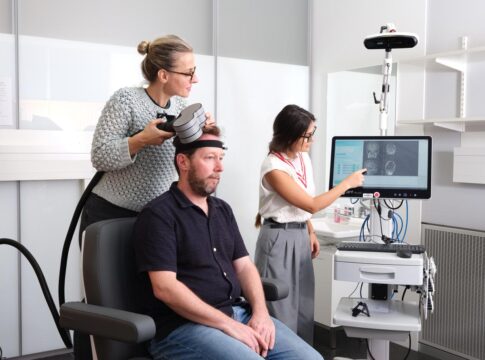
Stimulation cérébrale non-invasive pour les déficits de motivation
Intervenir sur l'apathie
Chercher des réponses dans le cervelet avec la neuroimagerie et la stimulation cérébrale
Les recherches en neuroimagerie menées au Campus Biotech suggèrent...